
Lana had brilliantly defended her thesis titled “Joint evolution of female multiple mating and dispersal in spatially structured populations“, where she used experimental evolution on the seed beetle Callosobruchus maculatus to tackle the challenging task of unravelling the joint eco-evolutionary dynamics of dispersal and costly female multiple mating in the context of inbreeding, and their feedback in spatially structured populations and under range expansion. Watch this space for upcoming papers!
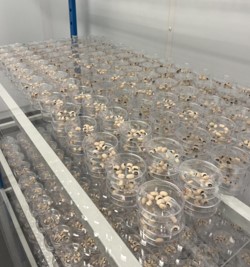
- Lana experimentally evolved the seed beetle for 25 generations in spatially structured populations with three different levels of dispersal to test the theoretical predictions of the evolution of female multiple mating in spatially structured populations as means of inbreeding avoidance and fertility assurance. Results revealed temporally changing dynamics of female multiple mating intertwined with potential feedbacks with female fecundity, male fertility, and the dynamics of the genetic load in the population, suggesting a prominent role of fertility assurance in driving female multiple mating in small and spatially structured populations. Additionally, females changed their egg allocation trough time, moving towards a more homogeneous distributions of eggs across multiple mating, pointing towards a bet-hedging strategy against infertility.
- After observing female biased dispersal in C. maculatus, Lana designed experiments to disentangle the role of density, female resource competition and male harassment in driving sex-biased dispersal. She found that female dispersal was driven both by competition for oviposition sites when mated and by male harassment.
- Dispersal and female multiple mating have been hypothesized to evolve as strategy to avoid inbreeding. However, despite extensive work on these two processes, their joint evolution and feedback on each other and on inbreeding remain largely unexplored. To investigate these questions, Lana used C. maculatus in an evolutionary experiment for 20 generations in spatially structured populations with three dispersal cost treatments. She was able to reveal a negative correlation between dispersal and female multiple maring in spatially structured populations, supporting the hypothesis that they evolve as competing inbreeding avoidance strategies (Bocedi, 2021).
- As inbreeding depression is known to be a common driver of the evolution of dispersal and female multiple mating, and inbreeding risk is expected to increase at expansion fronts due to small population sizes, we could expect a mutual feedback between dispersal and female multiple mating during range expansion. However, predicting how dispersal and female multiple mating could jointly evolve during range expansion is not straightforward. Using the seed beetle in a range expanding experiment during 16 generations, Lana aimed to unravel these processes.
 Greta Bocedi's Research Group